Sarnath Joins the UNESCO World Heritage List: A Universal Landmark of Peace and Wisdom
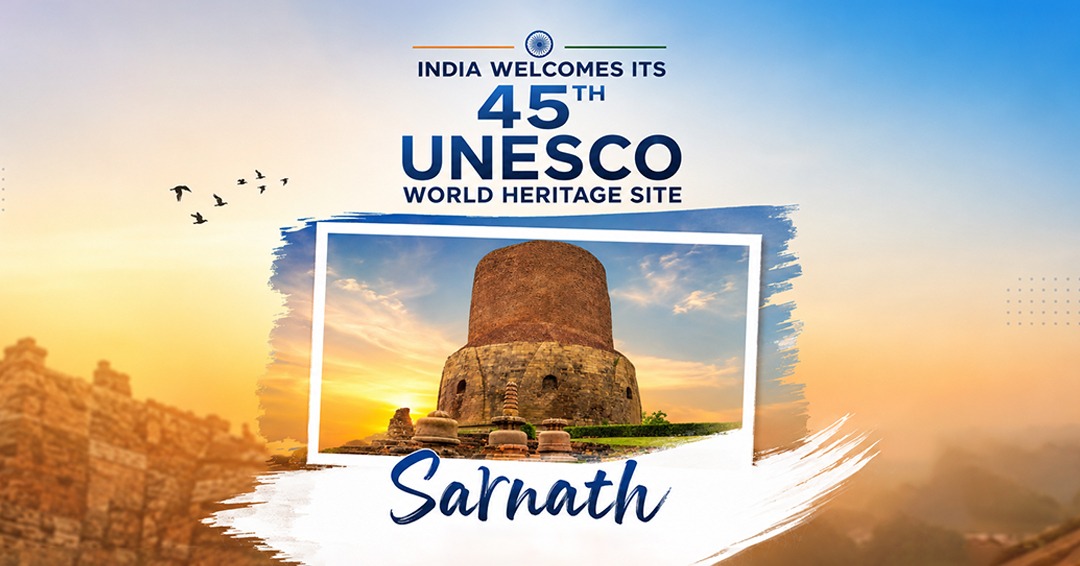
In a landmark recognition of India’s spiritual and historical legacy, the ancient Buddhist site of Sarnath in Uttar Pradesh has officially been inscribed on the UNESCO World Heritage List.
Prime Minister Narendra Modi hailed the global recognition as a proud moment for every Indian, emphasizing that Sarnath’s deep historical association with Lord Buddha—whose timeless messages of peace, compassion, and unity continue to inspire humanity—remains a beacon of India’s civilisational heritage. Union Minister for Culture and Tourism Gajendra Singh Shekhawat echoed these sentiments, describing the inscription as a defining moment that reaffirms India’s role as a cradle of ideas that shaped global philosophy.
Why Sarnath Holds Universal Significance
Located just 10 kilometers northeast of Varanasi, Sarnath is one of the four most sacred pilgrimage sites in Buddhism. It was in the Deer Park (Isipatana) at Sarnath that Lord Buddha delivered his first sermon to his five former companions after attaining enlightenment at Bodh Gaya. This historic event, known as the Dharmachakra Pravartana (the Turning of the Wheel of Law), marked the founding of the Buddhist Sangha (monastic community) and laid down the core tenets of the faith:
- The Four Noble Truths: The fundamental diagnosis of human suffering and the path to overcome it.
- The Noble Eightfold Path: Practical guidelines for ethical conduct, mental discipline, and spiritual wisdom.
Over the centuries, Sarnath grew into a monumental center of learning, art, and pilgrimage, thriving under major Indian empires—most notably during the reign of Emperor Ashoka in the 3rd century BCE.
Architectural and Cultural Treasures at the Site
Sarnath’s landscape is home to extraordinary archaeological monuments that showcase ancient Indian craftsmanship and architectural genius:
- Dhamek Stupa: Standing over 43 meters tall, this massive cylindrical structure marks the exact location where Buddha preached his first sermon.
- Ashoka Pillar & Lion Capital: Emperor Ashoka erected a polished sandstone pillar here. Its famous Lion Capital—featuring four Asiatic lions standing back-to-back atop a wheel (Chakra)—was adopted as the National Emblem of India in 1950.
- Chaukhandi Stupa: An ancient shrine marking the spot where Lord Buddha met his first disciples.
- Sarnath Archaeological Museum: Houses a pristine collection of Buddhist art, sculptures, and inscriptions dating from the Maurya to the Gupta periods.
Boosting Global Cultural Tourism
The official UNESCO World Heritage status elevates Sarnath on the international stage, promising to boost spiritual tourism, preserve its physical integrity, and foster educational research. As global travelers seek meaningful, heritage-rich destinations, Sarnath stands ready to welcome pilgrims and explorers eager to connect with one of humanity’s greatest intellectual and spiritual movements.